
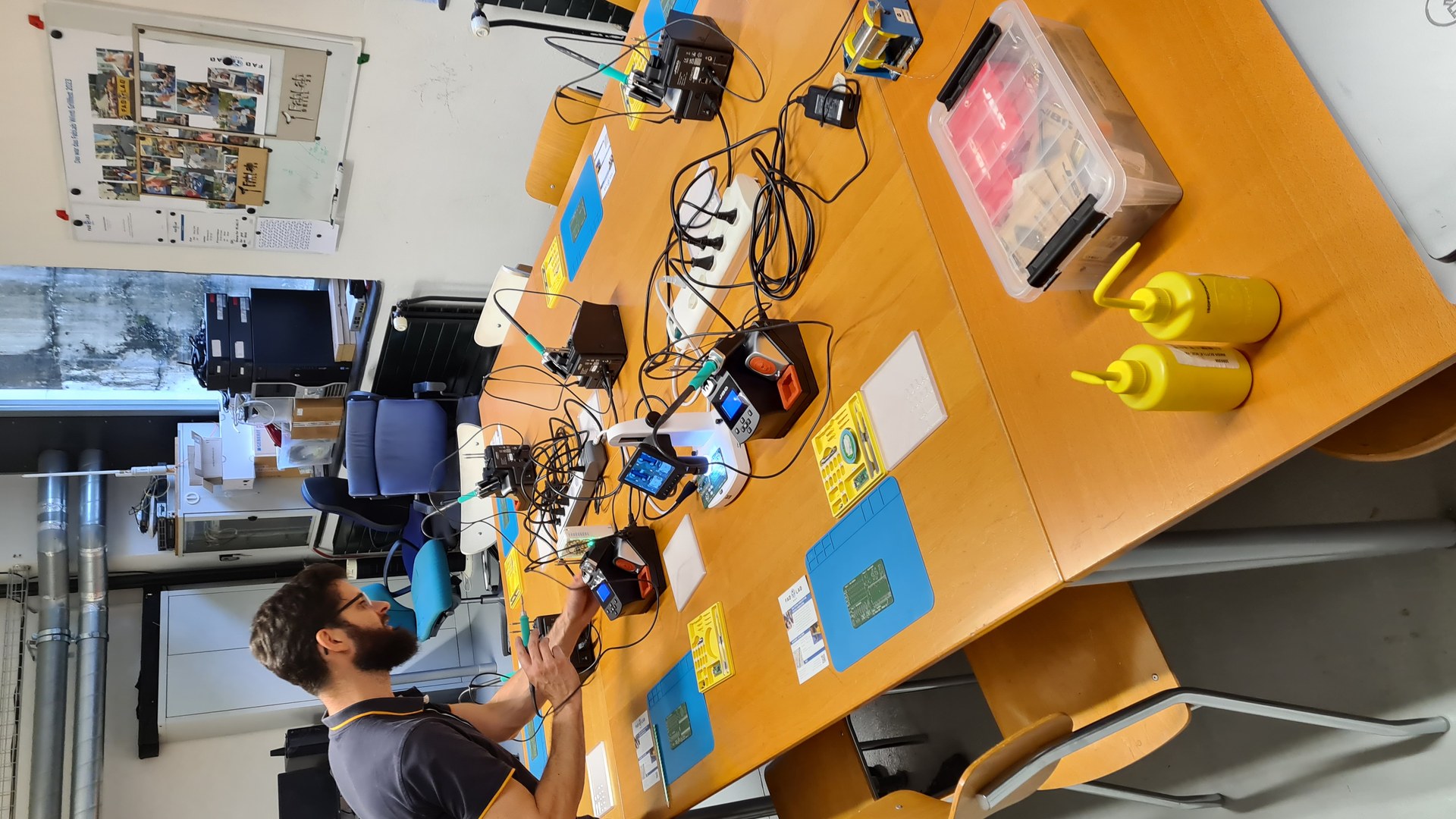
Makers and amateur radio
Practical maker projects for radio amateurs — from your first microcontroller and software-defined radio right through to ready-to-follow building guides.
The maker movement is dedicated to building, repairing and experimenting — with creativity, collaboration and the latest technology. What used to be called ‘tinkering’ and DIY is now the maker scene. It shares the same curiosity as amateur radio: understanding things for yourself, building them yourself, improving them yourself.
Anyone new to amateur radio will find projects and starting points here — and those who are already QRV will find new ideas for the workbench.
Getting started — where to begin?
Three areas where makers and radio amateurs overlap most closely today:
- Microcontrollers — the ESP32 and Raspberry Pi are the all-rounders: Wi-Fi and Bluetooth already built in, reading sensor data, controlling antennas and rotors, automating measuring equipment. ESP32 · Raspberry Pi
- Receiving with SDR — a radio receiver as software: receive and decode aeronautical radio, weather satellites or ADS-B aircraft data using affordable hardware. Pure reception does not require a licence. SDR on uska.ch
- Licence-free wireless networking — LoRa on the 868 MHz ISM band, Wi-Fi and Bluetooth: networked sensors, telemetry and mesh networks with ready-made firmware such as Meshtastic.
Licence-free radio projects — the ISM band
Many projects can be built and operated entirely without a radio licence — on the licence-free ISM/SRD bands (433 MHz, 868 MHz, 2.4 GHz). DIY ideas:
- LoRa on 868 MHz (ISM) — licence-free wireless networking with ultra-low power consumption over long distances: sensors, telemetry and mesh networks with Meshtastic.
- 433/868 MHz modules — reading, decoding and controlling wireless sockets, weather stations and sensors.
- Wi-Fi, Bluetooth & Zigbee (2.4 GHz) — networked devices, telemetry and home automation.
- Reception with SDR — receive aviation radio, weather satellites or ADS-B; reception only is licence-free. SDR page
- Measurement and antenna technology — GPSDO, antenna analyser, spectrum analyser.
- Inspiration from the maker world: Hackaday · Elektor
And with an amateur radio licence? Then you gain access to dedicated frequency bands, higher transmission power and projects such as the HAMNET high-speed network, digital modes (JS8Call, VARA, Codec2) or LoRa-APRS on 433 MHz — as an iGate or tracker. How do I become a radio amateur?
Build guides & circuits — Elektor collection
A curated collection of Elektor build guides to follow — from simple receivers to measuring instruments. The downloads are freely available.
Radio technology
- Build guide for an aviation radio scanner (Elektor)
- [DE] Concept: Receiver for 1–30 MHz
- [DE] Elektor Issue 10 — Straight-through receiver
- [DE] Elektor Issue 11 — Reflected-wave receiver
- [DE] Elektor Issue 12 — Reflex receiver with MOSFETs
Circuits
- [DE] Issue 1 — Staircase circuit
- [DE] Issue 2 — Energy-efficient relay
- [DE] Issue 3 — Energy-saving relay
- [DE] Episode 4 — AGC
- [DE] Episode 5 — Thyristor Tester
- [DE] Episode 6 — Watchdog with the 555
- [DE] Episode 7 — Audion
- [DE] Episode 8 — Electronic Candle
- [DE] Episode 9 — Twilight Switch
Measuring
- Radiation meter for alpha, beta and gamma radiation (Elektor)
- [DE] Arduino temperature logger
- [DE] Capacitance Meter
- Raspberry Pi as a voltmeter (Elektor)
Power supplies and regulators
- USB to AAA adapter (Elektor)