
Ferien(S)pass Guidelines
Tried-and-tested guidelines from the USKA Thun Branch for branches wishing to organise a ‘Ferien(s)pass’ day featuring amateur radio for children.
How do I organise a ‘Ferien(S)pass’ activity with my club?
A brief look back, or how it all began…
Many local authorities or valley communities offer a holiday pass for children in the region during the summer holidays. The programme, for example in Thun, now comprises around two hundred events, ranging from a visit to the fire station to football, handball and volleyball courses, macramé, pizza-making, photography and golf, right through to the absolute hit: a visit to the vet. The organisers include companies, private individuals and, above all, clubs from a wide variety of sectors.
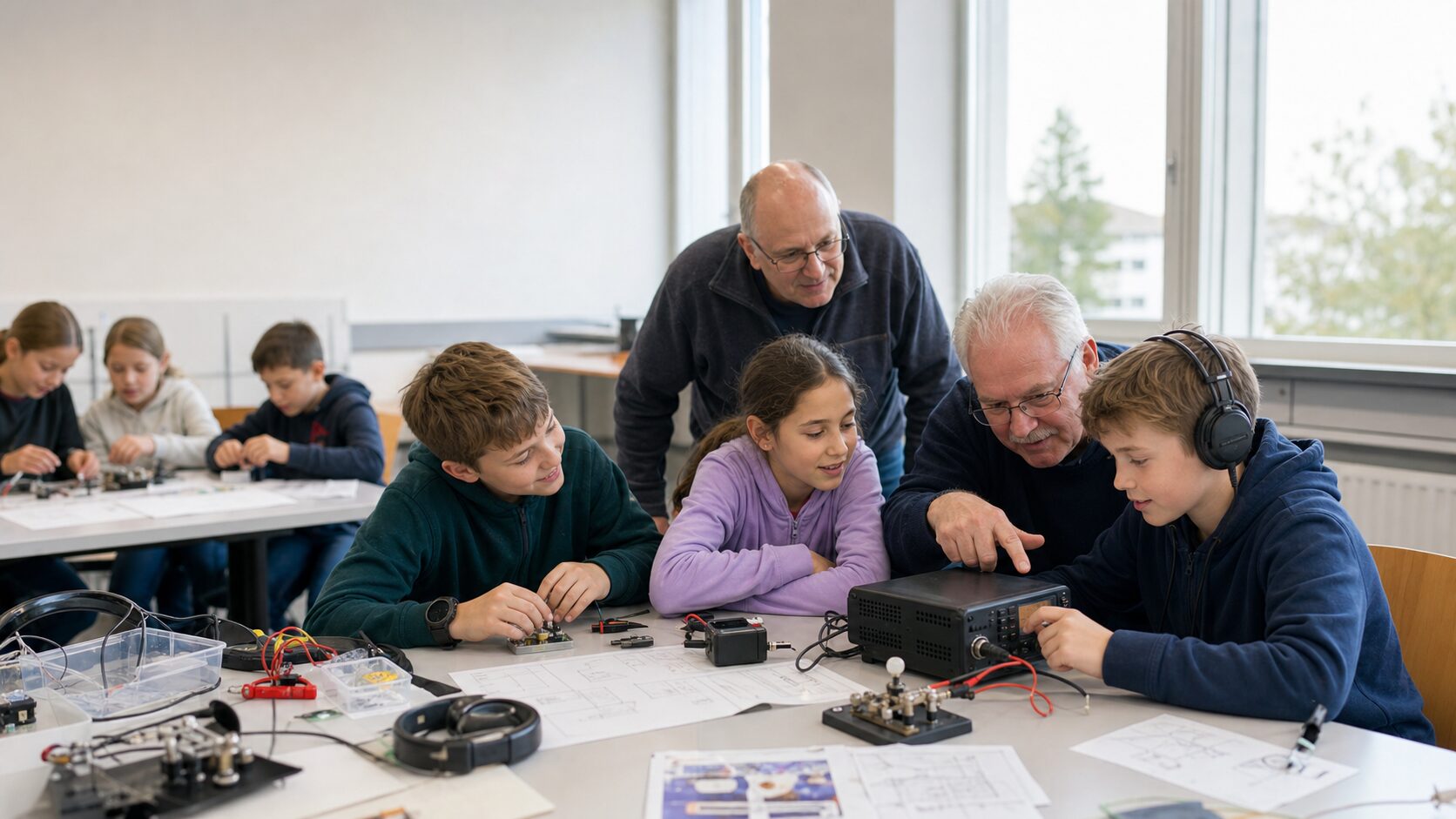
Bruno, HB9CNY, who was the president of the Thun local group at the time, also came up with the idea of offering our hobby as part of the ‘Ferien(s)pass’ programme to introduce children to amateur radio. Three or four children would attend each session at Bruno’s home, which initially lasted one day at a time. Essentially, Bruno showed the children his station, taught them some theory and helped them make radio contacts.
The Thun Model Flying Club has consequently decided to expand the ‘amateur radio’ holiday programme and extend it to three days. Each season, up to fifteen children can be welcomed to the hut provided by the Thun Model Aeroplane Club. Divided into three groups, they solder kits, practise Morse code and carry out radio operations using microphones approved by BAKOM.
Radio discipline is taught in a playful way using PMR radios, with fleet manoeuvres involving radio reconnaissance – a tricky variation on the well-known game of ‘Battleship’ – proving very popular with the children. The highlight on the third and final day is always the search for a ‘fox’ hidden in the woods using a direction-finding receiver.
During the 2006 holiday programme, the children were so enthusiastic about amateur radio as a hobby that they approached us of their own accord to ask whether we would run a course leading to the HB3 licence. Thanks to the initiative of Ernst, HB9TLF, a course with around twenty participants was launched in the winter. As most members of the Thun HB9T section (formerly HB9N) had previously worked positively and cooperatively with Citizens’ Band (CB) radio operators, there have long been good relations between the two ‘groups’ in Thun.
As it turned out, our first course was attended by participants in the ‘Ferienpass’ programme and a third of CB radio operators. With the exception of one very young ‘Ferienpass’ participant, everyone passed the BAKOM exam for the HB3 licence!
So, how do I go about organising a place on the ‘Ferien(S)pass’ programme?
Holiday Pass (FP)
A guide explaining how a radio amateur can run a ‘Ferienpass’ activity.
Tried and tested by the USKA Thun Section HB9T
1. Team
In accordance with the programme, as explained in section 4, a team of at least six OM’s is required for 9–15 participants.
2. Participants (TN)
9–15; if there are 15 or more participants, the team must be increased by 1 OM for every 3 participants. If there are fewer participants, consideration may be given to offering a ‘reduced programme’ with fewer OMs, without a venue, in the team members’ respective homes.
3. Local: Days 1, 2 and 3 tomorrow
Ideal:
- 1 room with a large table for soldering/construction projects
- 1 room, possibly with a seating area for operations
- 1 room for CW*
- An area with sheltered spots and places to hide the tracking foxes
- * = possibly also outdoors or in a large room in a different corner to the operating theatre. A room divider or a wool blanket curtain could be used in between.
- Affordable (depending on the support provided by the FP provider or the local branch’s financial resources)
4. Local, Day 3, lunchtime
- A covered outdoor fire pit, perhaps in the style of ‘Schweizer Familie’, with the option to hide a treasure.
- Affordable (depending on the support provided by the FP provider or the local branch’s financial resources)
5. Programme
- Everyone: Theory – What is amateur radio? What is the AFU allowed to do / not allowed to do? Wave propagation …
- Whether this theory is based on PowerPoint depends on the venue and the resources available. However, it is important to involve the children. For example, the propagation of waves can be explained very clearly using a torch and a table tennis ball.
- In groups: Craft – assembling a kit using soldering
- The USKA provides soldering kits on request for this purpose. Unfortunately, both kits must always be requested, as their contents differ. Furthermore, whilst the various pliers are undoubtedly of high quality, they are rather large for children’s hands.
- In groups: Radio operations on shortwave / VHF, Echolink(!) – possibly with scheduled contacts with section members whilst on holiday or at home.
- KW: Children can generally grasp distances such as ‘here – Munich’ or ‘here – Rome’. Conversations with domestic stations – whether at home or on holiday – are therefore generally preferable to exotic DX contacts with an English-speaking station, if only because of the young participants’ language comprehension.
- VHF: Relay links are particularly popular because the stations ‘at the other end’ are usually easy to understand. Demos using Echolink via iPhone are also very well received. The kids are particularly fascinated by the transmission delay.
- In groups: Morse code – a short course on sending and understanding signals and spelling out names in Morse code – a historical overview
- The simplicity of Morse code – the very first ‘digital signal’ – can still captivate young people today.
- In groups: PMR 446 operation – The same frequency – Call signs – Rules of communication – Sinking the boat
- The children are each given a PMR 446 device. Each device is set to a different channel. Without any further explanation, the children are now allowed to ‘start chatting away’, each in their own corner. After a few moments, the children realise for themselves that it doesn’t work like that and figure out the reason why. Now, with everyone on the same channel – still in their own corners – chaos ensues without any call signs. After a short while, the children become frustrated because ‘it just doesn’t work like that’. Now the participants are ready to learn about ‘radio discipline’. The call signs can simply be their first names. After a few question-and-answer exchanges (What are you doing in the holidays? – Why have you come to this holiday programme? Etc.), they can play ‘Battleship’ against each other. First, of course, the game – although most are familiar with an electronic version – must be explained in a way suitable for radio communication, using paper and pencil. Game sheet attached
- All / In groups: Radio direction-finding – theory and practice
- Theory: using the signal from a hidden transmitter and a direction-finding receiver – which is fitted with a loudspeaker instead of headphones – we ‘demonstrate’ the signal to the children. After their first successful search as a group, the children are allowed to use the direction-finding receiver in groups to locate a newly hidden transmitter themselves.
- On the final day, the venue is tidied up in the morning, and any equipment that was not already dismantled by the participants the evening before is taken down and put away.
- One team member has now placed a transmitter at a suitable fire pit and switched it on. Based on the existing direction-finding signals, ‘search groups’ are formed, which, accompanied by team members, now locate and search for the transmitter from a greater distance (1–2 km). Meanwhile, a cosy fire is burning in the fire pit for the cervelats and other food we’ve brought with us.
- Depending on the layout of the campfire site and the time available, an ‘individual direction-finding competition against the clock’ may also be held. It is advisable for team members to monitor the area. (180°!) Transport to and from the direction-finding area / campfire site, possibly by car. Sample programme attached.
6. Materials
- Name badges for participants (by colour / group) and team
- Soldering equipment (possibly the USKA soldering kit)
- Radio station including antennas (possibly section equipment)
- 5–6 PMR 446 units
- Play arch for ‘Sink the Boats’ with clipboard / writing pad
- Morse code instruction materials, various keyers with a learning aid, writing materials
7. Preparation
-
Decision on whether the FP programme should be offered by the section
-
Is the OM team at full strength?
- Who can bring some equipment? (Soldering irons, etc.)
- Have you found a suitable venue?
-
Is the OM team at full strength?
If the answer is ‘YES’ twice, the conditions are met.
- Apply to BAKOM for a broadcasting licence
- Once all participants are known: form groups by age / school year (where possible, keep villages and school years separate to prevent ‘clan formation’!)
8. Timetable (Starting point: FP mid-July)
Spring
- Putting together the OM team, allocating tasks
- Order any soldering materials from the USKA
- Request promotional material from the USKA
- Create a section for promotional material
February
- Submitting an application to become a provider in the FP
- General Meeting approval of the FP in the Local Branch’s annual programme
- Book a venue (you may wish to book in advance)
- Booking a fire pit (you may need to book in advance)
- Taking stock / Purchasing the kits
- What should the radio station look like? Antennas (ideally FD4 / G5RV etc.)
- Request equipment from the section (direction-finding equipment / antennas / possibly TRX)
- Apply to BAKOM for a broadcasting licence
Immediately before FP
- Preparing name badges
- Is there any USKA / Section promotional material available?
- Check that all the necessary materials will be on site