
Antenna Regulations: Information for local authorities
Information for local authorities and cantons regarding amateur radio antennas
Due to the constant need to expand mobile communications services and the public’s growing concerns about new technologies, local authorities feel compelled to exercise greater control over the siting of mobile phone masts. This is understandable. However, it is often overlooked that, in addition to mobile phone masts, there are various other types of antennas which should also be clarified in a municipality’s building and zoning regulations when the Antenna Act is revised. Case law in recent years has shown that the regulations for mobile phone masts could also be applied to other transmitting masts if the Act does not clearly distinguish them from other types of masts. (See the judgement of the Administrative Court of the Canton of Bern 100.2015.98U KEP/GEU/RAP).
With this information, we wish to assist local authorities in drafting a suitable provision on antennas and to highlight some fundamental technical and operational aspects of antennas and their transmitting equipment.
.
Types of antennas
For structural, high-frequency technical and physical reasons, antennas can be divided into the following three main categories:
a) Mobile communications antennas — Large, complex and usually conspicuous structures. They involve high investment costs. The installations are unattended. The location can therefore be adapted to local conditions to a certain extent. They are used to transmit and receive signals and are subject to the Federal NISV regulations. The transmitters operate 24 hours a day, 7 days a week. They serve a commercial purpose (telecoms services).
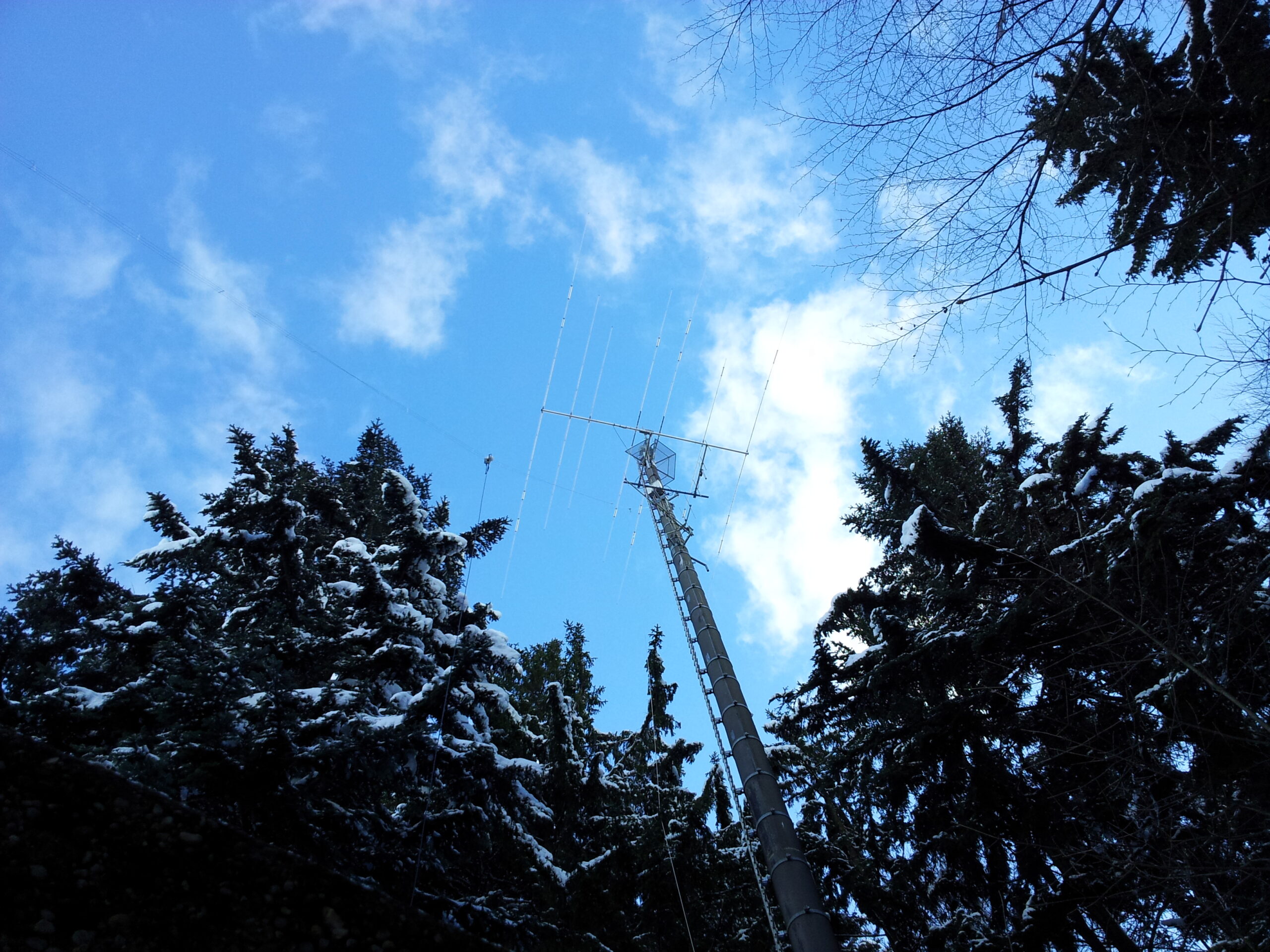
b) Antennas for other radio applications — Antennas for radio installations used in commerce, industry, emergency services (e.g. the fire service), municipal utilities, etc., as well as for amateur radio and CB radio. Each radio installation requires its own antenna. For technical reasons, the radio installation and the antenna must be located close together (at a maximum distance of approx. 50 m). They are therefore site-specific, usually situated in a residential or commercial area. These radio installations are intended for personal use and serve no commercial purpose. These antennas are also subject to the NISV. However, the transmission time of such radio installations is usually short — they normally fall under the NISV regulations for stations with fewer than 800 transmission hours per year. The potential radiation exposure is several orders of magnitude lower than that from mobile phone masts. There are usually only a few such radio installations within a local authority area.
c) Receiving-only antennas — In particular, antennas for receiving radio and television programmes, mostly satellite reception systems. These antennas are also fixed in position. Receiving antennas may be shared by a large number of households. However, as they do not transmit, they are not subject to the NISV — only regulations relating to the appearance of the local area and other planning criteria apply.
The local authority/planning department can address this issue in an antenna regulation in two different ways:
- Only ‘mobile phone masts’ are regulated. In that case, however, it should be clearly stated that the rules laid down apply only to mobile phone masts. Other types of antennas would thus remain undefined and unregulated. It would then be at the discretion of the planning authority to assess the eligibility for authorisation of such applications on a case-by-case basis.
- Corresponding regulations are enacted for each of the three types of antenna (mobile communications, other radio applications, receiving antennas). Or…..
Antenna Act within the national Telecommunications Act (FMG)
A new Telecommunications Act (FMG) came into force at federal level on 1 January 2021. A new article has been included in this Act in favour of radio amateurs. It reads:
Art. 37a amateur radio
1 The authorities may provide for a simplified authorisation procedure for simple wire and rod antennas, as well as for antennas on light masts with an appearance similar to that of flagpoles.
2 The maintenance or replacement of an antenna with one of a similar size does not require authorisation.
Building legislation falls within the remit of the cantons and municipalities. The new Article 37a of the FMG set out above calls on the cantons and municipalities to apply a simplified authorisation procedure (notification procedure) for simple amateur radio antennas.
As every transmitting antenna above a certain power level is subject to the Federal Ordinance on Electromagnetic Fields (NISV), even simple transmitting antennas must undergo a standard authorisation procedure, even though in many cases they are not structures in the strict sense of the term. This also applies to simple wire and rod antennas, which are usually built by radio amateurs themselves, and is disproportionate. It deters, in particular, young radio amateurs who are still in training and who have neither the knowledge, the resources nor the experience to go through a full, formal building permit procedure.
The planning authorities are therefore urged to keep the requirements for the planning process to a minimum for such simple antennas. It is disproportionate to require the same procedure and the same fees for a simple wire or rod antenna – similar to a flagpole – as for a full-scale structure.
The USKA Antenna Commission is happy to assist building authorities in regulating antenna-related issues within their building legislation
Contact via: ant@uska.ch

