What is amateur radio?
Technology, communication and community — an introduction to the diverse hobby of amateur radio.
The fascination of wireless communication

▶ Amateur radio in 60 seconds
: A brief insight into the hobby of amateur radio (YouTube).
My first experience of amateur radio
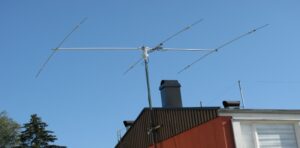
Amateur radio is a technical hobby that brings together people with an interest in electronics and communications. It is likely that almost everyone has come into contact with amateur radio at some point, whether consciously or unconsciously. Anyone who walks through towns and villages with their eyes open and lets their gaze wander attentively over the rooftops will usually spot something quickly. Amateur radio stations require antennas, wires, vertical rods or eye-catching, often quite elaborate structures. Amateur radio operators are open-minded and more than happy to answer questions. The best way is to make personal contact with an active radio amateur who will be happy to provide information and grant access to their station.
Local associations are also ideal points of contact. You can find the addresses and websites of regional associations here. Enquiries can also be sent directly to the ✉ USKA secretariat. In all cases, please state where you live so that you can be referred to the nearest point of contact.
How to become a radio amateur
Many radio amateurs stumbled upon this exclusive hobby quite by chance. Others were introduced to it through vocational training, whilst others still first came into contact with wireless communication as part of their military training. Everyone has their own personal journey.

Radio amateurs must pass an examination as a prerequisite for their activities. In Switzerland, this examination is set by the Federal Office of Communications (BAKOM) and covers the fundamentals of electrical engineering and electronics, as well as regulations governing the construction and operation of radio stations. The necessary knowledge can be acquired either at specialist schools, through distance learning courses, or by attending courses – usually with weekly lessons – such as those offered by some sections of the USKA or other groups.
Since 2003, it has no longer been necessary to demonstrate the ability to receive and transmit Morse code for shortwave operations. Nevertheless, Morse telegraphy continues to be practised as an extremely efficient mode of operation and remains widely used.
Further information: How do I become a radio amateur?
Amateur radio is very diverse
It is virtually impossible to provide a comprehensive overview of the opportunities that amateur radio offers to those involved. On this page, we highlight aspects of individual areas and provide links to further sources of information.
Amateur radio is a field of experimentation from which, time and again in the past, pioneering technologies and methods of information transmission have emerged. This has remained the case from the very beginnings of wireless communication right up to the present day. Since the invention of Morse telegraphy and voice radio, many new digital forms of wireless communication have emerged in recent decades. The fact that a radio link can be established across continents with minimal technical effort never ceases to fascinate.
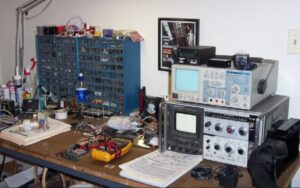
Computer enthusiasts will find just as many opportunities to develop their skills here as talented hobbyists. One of the unique aspects of this hobby is the opportunity to build and operate electronic devices yourself. In the past, this DIY aspect was highly valued, but today it has largely been replaced by a very wide range of commercial products. Radio amateurs, however, are still tinkerers and ‘inventors’ today. Even setting up one’s own radio station requires creativity and the development of original ideas for selecting equipment and building antennas.
For many people, this hobby is an ideal way to keep up their foreign language skills. However, it also offers the opportunity to make contact with other radio amateurs all over the world, even without being fluent in their language. The key to this is Morse code, or telegraphy.
The radio station
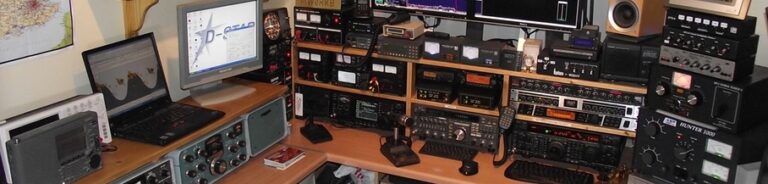
Every radio amateur sets up their radio station according to their own preferences and means. The variety of set-ups is endless. The most basic option is a small radio unit that sits inconspicuously in a corner of the flat, waiting to be used. Fortunate indeed are those who have a room of their own dedicated to their radio station. Such rooms exude a blend of cosiness and fascination that one simply must experience. However, all set-ups have one thing in common: the technical components have been selected with great expertise and are cherished and well looked after. It is often the case that both very modern equipment and nostalgic transceivers can be found at the same station. There are hardly two radio stations with an identical technical setup.
How much does a radio station cost? That’s a question we’re often asked. With second-hand equipment and simple antennas, you can set up a fully functional station with relatively little effort. There’s no upper limit. Everyone decides for themselves how much to invest — just like when buying a car.
By the way: the image of a radio amateur sitting at a dimly lit radio station, headphones on, long into the night, isn’t all that far off the mark.
The operating modes
By ‘operating modes’, we mean the various technical methods of transmitting information.
The oldest mode of operation is telegraphy (Morse code). The Morse alphabet, invented around 1840 by Samuel Morse, is still used today in its original form. Internationally standardised abbreviations are used here — a sort of ‘amateur radio Esperanto’, so to speak. This allows the time required for transmission to be kept to a minimum. It also enables people who do not speak a common language to communicate with one another. An example:
Telegraphy: tnx fer ufb qso / hpe cuagn / best 73
Plain text: Thank you for the excellent connection / I hope to contact you again / best regards
Why is telegraphy still so relevant today? A brief digression: the bandwidth of a telegraphic signal is only about 10 per cent of the bandwidth required for a voice radio link (SSB). Telegraphy therefore requires only one-tenth of the transmit power to be received at the same field strength — or, to put it another way: with telegraphy and a given transmit power, distances can be bridged that are not possible with voice radio. The technical effort required to generate a Morse signal is much less than that needed to process the modulation for voice radio. Enthusiasts of low transmit power (QRP) are therefore particularly drawn to telegraphy.
Telephony, also known as voice radio, is communication using plain speech. Amplitude modulation (AM) was superseded by single-sideband (SSB) technology. Frequency modulation (FM) is mainly found on frequencies above 144 MHz and in some parts of the 10-metre band. Radio communications require an appropriate level of language proficiency.
Digital modes of operation are developments whose diversity only became possible with the widespread adoption of computer technology. AMTOR, PACTOR, Packet Radio, BPSK and teletype (RTTY) are just a few examples. Some of them are characterised by the fact that very long distances can be covered using minimal transmit power. One of the newer modes is FT8, which allows connections to be established even when the signal is buried deep in the noise — a fact that has led to an explosive rise in the popularity of this mode since 2017. A very special digital mode is the transmission of colour images via amateur radio television (SSTV) on shortwave.
Amateur radio serves the public
Radio amateurs possess unique skills. A wide variety of organisations therefore recruit their staff from our ranks. Certain special forces units within the army consist mainly of radio amateurs. Many of our colleagues have been deployed somewhere in the world on behalf of the International Committee of the Red Cross (ICRC) or Swiss Disaster Relief. On numerous occasions, radio amateurs have been able to organise assistance in emergencies worldwide or ensure communication between disaster areas and emergency services. Members of the Union of Swiss Shortwave Amateurs (USKA), as well as organisations in other countries, have organised themselves regionally and nationally in the field of ‘emergency communications’.
Further information
- The New Handbook for DXers. Author: Bryce K. Anderson, K7UA. German translation by Manfred Hübsch, OE5HIL. Source: k7ua.com
- BAKOM — Amateur radio in Switzerland (regulations, licences, examinations)
- How do I become a radio amateur?
- Information for members of the press